
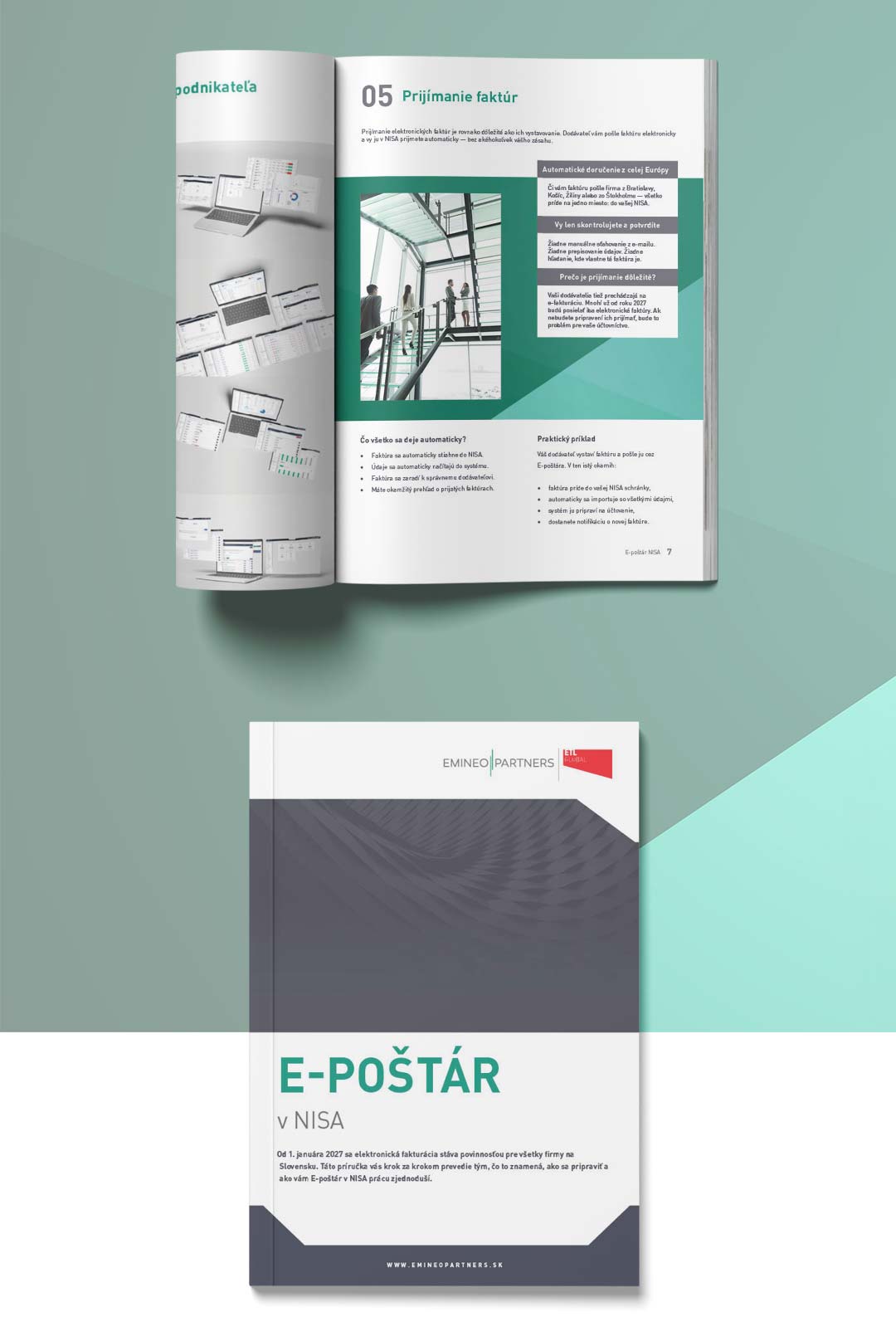
E-book to download
E-invoice
Download the e-book and find out how e-invoicing will affect your business starting January 1, 2027
An audit isn’t just an obligation: what a company should sort out before an audit
An audit does not begin on the day the auditor arrives.
For many companies, an audit is still viewed primarily as a legal obligation—something that must be done when a company reaches a certain size, prepares its financial statements, or needs to meet the requirements of its owners, a bank, or a corporate group.
In practice, however, an audit reveals much more than just whether a company has fulfilled its obligation.
It shows whether the company’s accounting is in order.
Whether it can substantiate its figures.
Whether the supporting documents are complete.
Whether the contracts match what’s in the books.
Whether the company understands its own receivables, liabilities, assets, and processes.
An audit, therefore, doesn’t have to be just a source of stress at the end of the year. If a company prepares for it on an ongoing basis, it can also be a useful tool for maintaining order and improving management.

When does an audit concern a company?
The audit requirement may apply in particular to companies that meet the statutory criteria under the Accounting Act. For business entities and cooperatives, the focus is primarily on size indicators, such as assets, net revenue, and the number of employees.
If a company is growing, joining a group, preparing for financing, an acquisition, a change in ownership structure, or regularly reporting to a parent company, an audit can also be important from both a practical and reputational standpoint.
It is important not to wait until an audit becomes an urgent requirement. A company should monitor in advance whether it is approaching the thresholds at which an audit becomes mandatory.
Accounting must make sense on an ongoing basis
It’s one thing to have your documents recorded in the books. It’s another thing entirely to have accounting records that the company understands and can defend.
Before an audit, it often becomes clear whether account balances are checked on an ongoing basis, whether expenses and revenues are recorded correctly, whether payments are matched, and whether bank accounts, receivables, payables, inventory, and assets add up.
If these issues are addressed only shortly before the audit, it creates pressure on the accountants, management, and the auditor. The company then treats accounting not as a management tool, but merely as an obligation that must be cleaned up retroactively.
Ongoing monitoring of the accounting system therefore saves both time and stress.
Got an audit coming up? Sort out any uncertainties now.
Do your figures match your supporting documents and contracts? EMINEO PARTNERS can help you review your accounting records and identify any issues that are worth resolving before the audit. So that your preparations aren’t left to a last-minute scramble.
Documents and contracts must be consistent with one another
During an audit, it is not enough for a company simply to have an invoice. It is also important to consider whether the expenditure or income makes sense in the context of a contract, purchase order, service provision, payment or internal approval.
A common problem is that the accounts are based on a document, but the wider context is missing. For example, a company may have an invoice on its books but is unable to produce the contract promptly. Or it has a signed contract which, in practice, is being fulfilled differently from how it is recorded in the accounts.
During an audit, it is therefore worth having a clear overview of contracts, purchase orders, amendments, internal approvals and supporting documents relating to significant transactions.
Receivables, payables and stock
An audit often raises the question of whether a company has a realistic understanding of the status of its receivables and payables.
It is not just the figures shown in the accounts that matter. It is also important to consider whether the receivables are actually recoverable, whether they are past due, whether the provisions have been correctly assessed, whether the liabilities reflect the actual situation, and whether there are any items that should already have been resolved.
The same applies to stock or assets. A company should know what it owns, what its value is, where the assets are located, and whether the accounting records match the actual situation.
If a company does not address these areas on an ongoing basis, an audit can very quickly bring them to light.
Audit as a management tool
A good audit can be beneficial to a company even beyond its legal obligations.
For an owner, managing director or finance director, an independent view of the accounts and processes can be important when making strategic decisions. For example, when negotiating with a bank or an investor, when selling a business, making an acquisition, joining a group, or setting up reporting systems.
An audit can reveal whether financial information is useful for managing the company. If the accounts are not checked on an ongoing basis, management may make decisions based on data that is incomplete or out of date.
An audit should therefore not be seen merely as a review of the past. It can also be a tool that helps a company prepare for further growth.
How EMINEO PARTNERS can help
EMINEO PARTNERS views an audit in the context of accounting, taxation and the day-to-day running of a business.
We help clients to continuously organise their accounts, documentation and internal processes so that the company does not have to sort things out only when an audit is imminent. Where necessary, the situation is assessed by a team comprising an accountant, an auditor, a tax adviser or a lawyer.
The aim is not to make the audit a stressful experience. The aim is for the company to have a clear overview, to be able to work with its data, and to have the necessary documentation ready so that the audit can proceed more efficiently.
You’re growing your business. We’re here to support you.
From day-to-day bookkeeping to important tax and legal decisions. At EMINEO PARTNERS, you’ll find a team that looks at your business in its broader context, not just through the lens of your accounts. With a personalised approach and the international backing of ETL GLOBAL.
The information provided on this website is intended to give a basic overview of tax, accounting and legal regulations. Under no circumstances does it serve as a guide for their practical application, which may differ significantly from the legislation in force at any given time. The information on this website does not constitute legal, accounting, tax or other professional advice or services. The information as such should not be regarded as a substitute for professional consultation with accounting, tax, legal or other advisers. EMINEO PARTNERS accepts no liability and assumes no responsibility for any inaccuracies, omissions or results obtained through the use of this information. All information and examples are provided without any guarantee as to their practical applicability. EMINEO PARTNERS is under no obligation to ensure that the information and examples provided on this website comply with applicable legislation.
Summary
An audit need not be stressful if a company keeps its accounts in order not just at the end of the year, but on an ongoing basis.& nbsp;For growing businesses, an audit is not only a legal obligation but also a practical tool that reveals whether accounting records, supporting documents, contracts, receivables, stock, assets and internal processes are organised in a clear and comprehensible manner.
In this article, we explain why an audit does not begin on the day the auditor arrives, what a company can check in advance, and why it is beneficial to view an audit as a management perspective on the company’s operations. A well-prepared audit can help not only with meeting regulatory obligations, but also when negotiating with a bank, an investor, an owner or a group.
Frequently Asked Questions (FAQ)
- When must a company have its financial statements audited?
The obligation to undergo an audit depends on the statutory criteria set out in the Accounting Act. For commercial companies and cooperatives, the main factors monitored are assets, net turnover and the average adjusted number of employees. If a company is growing, it should monitor these criteria on an ongoing basis.
- Is an audit merely a legal obligation?
No. An audit can also be a useful tool for owners, management, banks, investors or a group. It helps to verify whether a company’s financial statements and processes make sense.
- What does a company do to prepare for an audit?
These most commonly include financial statements, account balances, receivables, payables, contracts, supporting documents for significant transactions, asset records, stock, bank accounts and tax records.
- Why is it important to keep contracts in order?
This is because accounting documents often require a broader context. An invoice should correspond to a contract, a purchase order, the provision of a service or some other supporting document that explains the purpose of the transaction.
- How can a company reduce stress ahead of an audit?
It is best to deal with the accounts, documents and internal processes on an ongoing basis. If everything is only sorted out just before an audit, it creates pressure, leads to errors and results in unnecessary follow-up work.
- How can EMINEO PARTNERS help?
EMINEO PARTNERS helps companies organise their accounts, documentation, processes and tax affairs so that they are prepared for both audits and management decision-making.
Sources
Slov-Lex – Zákon č. 431/2002 Z. z. o účtovníctve
https://www.slov-lex.sk/ezbierky/pravne-predpisy/SK/ZZ/2002/431/
Slov-Lex – Zákon č. 423/2015 Z. z. o štatutárnom audite
https://www.slov-lex.sk/ezbierky/pravne-predpisy/SK/ZZ/1991/513/
Finančná správa SR – Usmernenie k povinnosti obchodných spoločností a družstiev na overenie účtovnej závierky audítorom
https://www.financnasprava.sk/_img/pfsedit/Dokumenty_PFS/
Zverejnovanie_dok/Dane/Metodicke_usmernenia/Priame_dane/2021/2021.05.27_27_DZPaU_2021_
MU.pdf
Register účtovných závierok
https://www.registeruz.sk/cruz-public/home
Slovenská komora audítorov – Štatutárny audit a audítori v kocke
https://www.skau.sk/statutarny-audit-a-auditori-v-kocke/
Slovenská komora audítorov
https://www.skau.sk/