
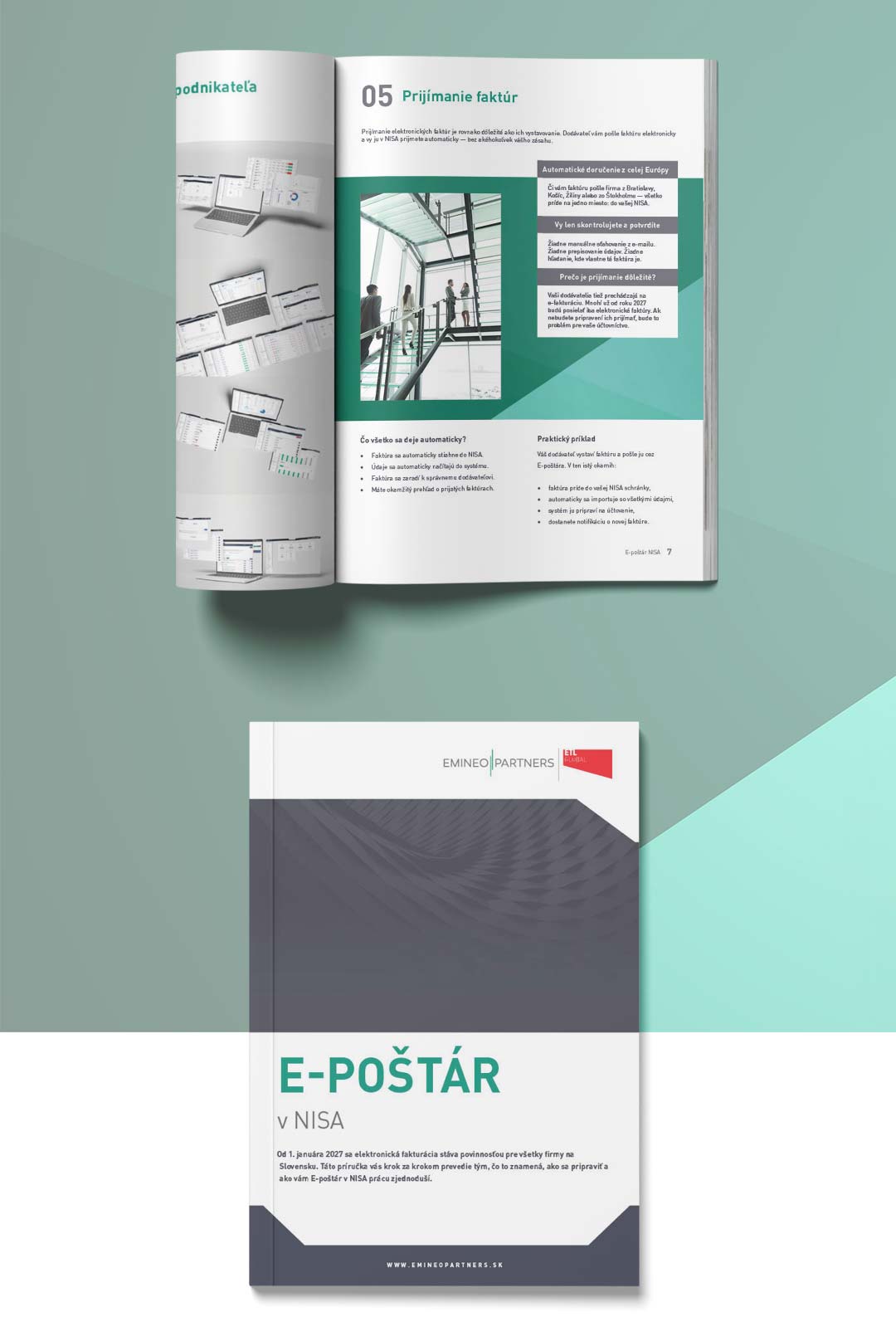
E-book to download
E-invoice
Download the e-book and find out how e-invoicing will affect your business from 1 January 2027
An employee working from abroad: working from home, payroll and tax risks
Working from home whilst abroad isn’t just a matter of having a laptop, an internet connection and your manager’s approval.
For an employee, this can be an attractive benefit. They might want to work from Croatia for a few weeks, relocate to the Czech Republic for a longer period, stay abroad after their holiday, or work remotely from a country where their family lives. From a practical point of view, it might seem that as long as the work continues and the results are delivered, the company has nothing to worry about.
However, from an employer’s perspective, working from abroad can raise more questions than it might seem at first glance.
It is not just a matter of where an employee switches on their laptop. It concerns employment arrangements, payroll, taxes, social security, health insurance, internal rules, data security and, in some cases, the risk of incurring liabilities abroad.

Working from home and working from abroad are not the same thing
Many companies have internal policies on working from home. However, these often assume that the employee is working from home or from another location in Slovakia.
If an employee starts working from abroad, the situation changes. The company should know in which country the employee will be working, for how long, under what arrangements, and whether this is a one-off exception or a long-term arrangement.
A short period of working from home whilst abroad may have a different impact to regular or long-term work from another country. That is precisely why a company should not treat all situations in the same way.
Place of work and work records
One of the first issues to consider is the employment arrangements. If an employee’s place of work is specified in their employment contract or in internal regulations, the company should assess whether working from abroad is consistent with the agreed arrangements.
What matters most is whether it involves occasional consent, regular remote working, a temporary secondment or another working model. This may involve rules on working hours, availability, the use of work equipment, data protection or health and safety at work.
In practice, it is worth clearly defining who can approve work abroad, for what period, in which countries and under what conditions.
Is the employee working from abroad?
We can help you review your company’s tax, payroll and employment obligations.
Social security and the A1 form
Social security is a separate issue. When working within the EU, the EEA, Switzerland or the United Kingdom, it may be relevant to determine which country’s legislation the employee is subject to.
Form A1 also serves this purpose, as it confirms the applicable social security legislation. When posting staff or working in several countries, it may be important for a company to know whether it needs such a document and how to apply for it.
From 1 September 2026, the Social Insurance Agency will also introduce a requirement for employers to submit applications for the PD A1 form electronically when posting employees to work abroad and when carrying out activities in several Member States simultaneously. This is yet another reason why companies should have their cross-border work processes under control.
An employee’s tax residence
During a prolonged stay abroad, the question of an employee’s tax residence may also arise. This is not just a matter of the number of days spent in the country, but also of other ties, such as place of residence, family, economic ties or habitual residence.
If an employee changes their tax residence or receives income from work physically carried out abroad, the way in which their tax obligations are settled may also change.
Internal rules are the foundation
Working from abroad need not be prohibited. For many companies, it can be a useful tool for flexibility and a competitive advantage when recruiting staff.
However, there must be rules.
The company should be aware that:
- who is allowed to work from abroad,
- from which countries is this permitted,
- for what period,
- who approves the application,
- what documents or information must an employee provide,
- who is responsible for payroll, tax and insurance,
- how data security is addressed,
- how work carried out abroad is recorded,
- when the situation must be assessed on a case-by-case basis.
Without clear rules, chaos can ensue in HR, payroll and tax matters.
How EMINEO PARTNERS can help
EMINEO PARTNERS helps companies assess remote working in a practical and contextual manner. It is not merely a matter of employment law or an employee benefit. It involves the interplay between HR, payroll, tax, social security, accounting and internal policies.
The aim is not to ban flexibility for companies. The aim is to structure it in such a way that it is workable in practice and does not create unnecessary risks.
If employees are working from abroad or the company is planning to adopt a remote working model, it is worth establishing rules in advance. This is to ensure that what starts out as a benefit does not turn into a problem that has to be dealt with retrospectively in relation to payroll, tax or employment documentation.
You’re growing your business. We’re here to support you.
From day-to-day bookkeeping to important tax and legal decisions. At EMINEO PARTNERS, you’ll find a team that looks at your business in its broader context, not just through the lens of your accounts. With a personalised approach and the international backing of ETL GLOBAL.
The information provided on this website is intended to give a basic overview of tax, accounting and legal regulations. Under no circumstances does it serve as a guide for their practical application, which may differ significantly from the legislation in force at any given time. The information on this website does not constitute legal, accounting, tax or other professional advice or services. The information as such should not be regarded as a substitute for professional consultation with accounting, tax, legal or other advisers. EMINEO PARTNERS accepts no liability and assumes no responsibility for any inaccuracies, omissions or results obtained through the use of this information. All information and examples are provided without any guarantee as to their practical applicability. EMINEO PARTNERS is under no obligation to ensure that the information and examples provided on this website comply with applicable legislation.
Summary
Working from home whilst abroad may, at first glance, seem like a simple perk. The employee has a laptop and an internet connection and can carry out their work from anywhere. From the company’s perspective, however, it is not simply a matter of trust or flexibility.
If an employee is working from abroad, a number of practical questions may arise: where the work is physically carried out, which employment law rules apply, where social security and health insurance contributions should be paid, how tax residence is assessed, whether there is an obligation to tax income abroad, and whether the company needs to amend the employment contract, internal policies or payroll processes.
In this article, we explain why companies should not simply allow employees to work abroad on an informal basis, and why it is necessary to establish a clear process before an employee leaves to work outside Slovakia.
Frequently Asked Questions (FAQ)
-
- Can an employee of a Slovak company work from abroad?
It is possible, but the company should not automatically authorise such an arrangement. It is important to assess the country, the length of stay, the job role, the place of work, payroll, taxes, social security and internal policies.
-
-
- Is a short period of working from home whilst abroad a problem?
-
This may not be the case, but even a short stay should be authorised and recorded. In the case of repeated or long-term work from abroad, further issues relating to tax, social security contributions or employment law may arise.
-
-
- What is an A1 document?
-
Document A1 confirms which country’s social security legislation a person is subject to. It may be important when posted or working in several countries.
-
-
- Can working abroad affect an employee’s tax residency?
-
Yes, particularly in the case of a longer or repeated stay abroad. Tax residence depends on the specific situation and the employee’s ties to individual countries.
-
-
- Why is a superior’s approval not enough?
-
This is because working from abroad is not just a matter of work organisation. It can have an impact on employment contracts, payroll, tax, social security, data protection and the company’s obligations.
-
-
- How can EMINEO PARTNERS help?
-
EMINEO PARTNERS helps companies organise remote working from an international perspective, covering pay, tax, social security, accounting, employment regulations and internal processes.
Sources
Slov-Lex – Zákon č. 311/2001 Z. z. Zákonník práce
https://www.slov-lex.sk/ezbierky/pravne-predpisy/SK/ZZ/2001/311/
Slov-Lex – Zákon č. 595/2003 Z. z. o dani z príjmov
https://www.slov-lex.sk/ezbierky/pravne-predpisy/SK/ZZ/2003/595/
Slov-Lex – Zákon č. 461/2003 Z. z. o sociálnom poistení
https://www.slov-lex.sk/ezbierky/pravne-predpisy/SK/ZZ/2003/461/
Slov-Lex – Zákon č. 580/2004 Z. z. o zdravotnom poistení
https://www.slov-lex.sk/ezbierky/pravne-predpisy/SK/ZZ/2004/580/
Finančná správa SR – Občania SR v zahraničí
https://www.financnasprava.sk/sk/obcania/dane/dan-z-prijmov/obcania-sr-v-zahranici/_1
Finančná správa SR – Príjem zo závislej činnosti vykonávanej v zahraničí
https://podpora.financnasprava.sk/030801-Pr%C3%ADjem-zo-z%C3%A1vislej-%C4%8Dinnosti-zamestnania-vykon%C3%A1vanej-v-zahrani%C4%8D%C3%AD
Finančná správa SR – Príjem zo závislej činnosti vykonávanej na území SR
https://podpora.financnasprava.sk/984868-Pr%C3%ADjem-zo-z%C3%A1vislej-%C4%8Dinnosti-zamestnania-vykon%C3%A1vanej-na-%C3%BAzem%C3%AD-SR—16-ods-1-p%C3%ADsm-b-z%C3%A1kona-o-dani-z-pr%C3%ADjmov
Finančná správa SR – Vyslanie zamestnancov
https://podpora.financnasprava.sk/417977-Vyslanie-zamestnancov
Finančná správa SR – Informácie o dani z príjmov pre zamestnávateľa
https://www.financnasprava.sk/sk/podnikatelia/dane/dan-z-prijmov/zamestnavatelia/info-dp-zamestnavatel
Finančná správa SR – Oznamovacia povinnosť podľa § 49a ods. 5 zákona o dani z príjmov
https://podpora.financnasprava.sk/993397-Oznamovacia-povinnos%C5%A5-pod%C4%BEa–49a-ods-5-z%C3%A1kona-o-dani-z-pr%C3%ADjmov
Sociálna poisťovňa – Ako požiadať o prenosný dokument A1
https://www.socpoist.sk/zivotne-situacie/praca-v-zahranici/ako-poziadat-o-prenosny-dokument-a1-praca-v-eu-ehp-svajciarsku
Sociálna poisťovňa – Prenosný dokument A1, otázky a odpovede k elektronickej žiadosti
https://www.socpoist.sk/zivotne-situacie/praca-v-zahranici/prenosny-dokument-a1-otazky-odpovede-k-elektronickej-ziadosti
Sociálna poisťovňa – Podávanie žiadosti o formulár PD A1 pri práci v zahraničí bude povinné výlučne elektronicky od 1. septembra 2026
https://www.socpoist.sk/node/7033
Ministerstvo práce, sociálnych vecí a rodiny SR – Určovanie príslušnej legislatívy pri koordinácii systémov sociálneho zabezpečenia
https://www.employment.gov.sk/sk/ministerstvo/medzinarodna-spolupraca/koordinacia-systemov-sz/urcovanie-prislusnej-legislativy/urcovanie-prislusnej-legislativy.html
Ministerstvo práce, sociálnych vecí a rodiny SR – Základné princípy koordinácie systémov sociálneho zabezpečenia
https://www.employment.gov.sk/sk/ministerstvo/medzinarodna-spolupraca/koordinacia-systemov-sz/koordinacne-pravne-predpisy.html
Európska komisia – EU social security coordination
https://employment-social-affairs.ec.europa.eu/policies-and-activities/moving-working-europe/eu-social-security-coordination_en